The Dismantling Project

The Dismantling Project is not a self-help project. It is a dismantling project.
Across thirty statements, it examines the structures people mistake for identity. Beliefs inherited without examination. Desires shaped by conditioning. Relationships used for completion. Fears disguised as logic. Patterns repeated in the name of safety.

Each piece targets a different mechanism through which the self is built and defended. The project does not offer solutions, healing frameworks, motivation, or transformation narratives. Its purpose is interruption. It strips away explanations, stories, and self-images until what remains cannot be avoided.

Presented as a series of brutal posters, each piece isolates a single observation and strips it to its bare form. Together, the thirty pieces move in sequence: from identity and belief, through attachment, control, fear, and meaning-making, to the final question of what remains when the noise stops.

The project ends where most self-improvement systems begin. Not with becoming something new, but with seeing clearly what was never yours.

Vickram Aadityaa | vickram.au

The Dismantling Project poster on identity performance by Vickram Aadityaa.

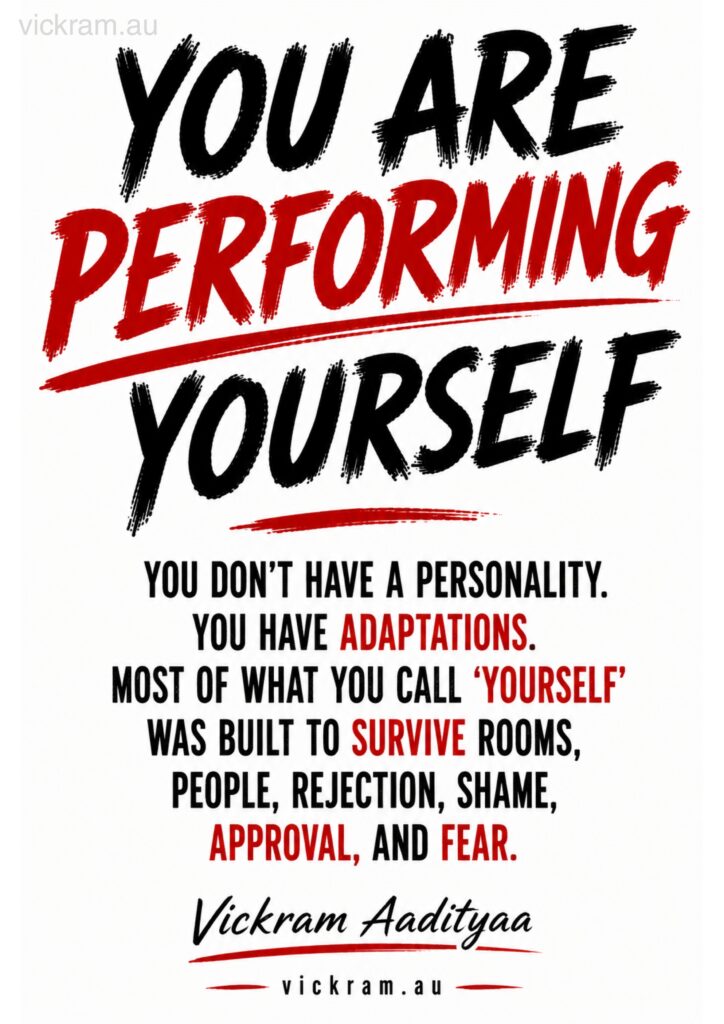
You Are Performing Yourself

The Dismantling Project

You did not arrive here as yourself. You arrived as a collection of responses to pressure. The personality you call yours was built in reaction to specific rooms, specific people, specific moments of rejection and approval and fear. It was not chosen.

It was assembled under conditions you did not control. Watch yourself in a room where you want approval. Watch yourself with someone you find threatening. Watch yourself when you are being evaluated. The version of you that shows up in each of those rooms is not the same.

You adjust the voice. You adjust the posture. You adjust what you say and how you say it. You do this without deciding to. It happens before thought. This is not dishonesty. It is adaptation. The problem is not that you adapted. The problem is that you forgot you were doing it. The adaptations calcified. They became the story you tell about who you are. The performance became the identity.

Most people spend their lives defending a character they built under duress and never examined. They protect it. They curate it. They feel threatened when someone challenges it. The threat is not to them. It is to the construction.

The question is not who you are performing. The question is what is doing the performing. You have been so busy maintaining the character that you have not stopped to ask who is behind it. Or whether there is anyone there at all.

Vickram Aadityaa | vickram.au

The Dismantling Project poster on image and identity by Vickram Aadityaa.

You Defend What You Never Chose

The Dismantling Project

Before you could think critically, you were given a set of conclusions. Family handed you a version of reality. Religion handed you a framework. Culture handed you a set of values and a set of enemies. Fear handed you a list of things to avoid.

You absorbed all of it before you had the tools to question any of it. These conclusions became your beliefs. Your beliefs became your identity. Your identity became something you protect. When someone challenges the belief, it does not feel like an intellectual disagreement. It feels like an attack on you. You feel it in the body. The tightening. The need to respond. The discomfort that does not go away until the threat is neutralised.

You are defending a script you did not write. The people who wrote it are not here. The rooms where you learned it no longer exist. But the defence mechanism runs anyway, because it was built into you before you knew what was happening. Most people never audit this.

They go through life assuming their beliefs are theirs because they believe them. But believing something is not the same as choosing it. You can hold a position your whole life and still have arrived at it by accident.

The question is not whether your beliefs are correct. The question is whether you have ever actually looked at them. Or whether you are still defending something handed to you by people who were themselves defending something handed to them.

Vickram Aadityaa | vickram.au
The Dismantling Project poster on familiarity and truth by Vickram Aadityaa.

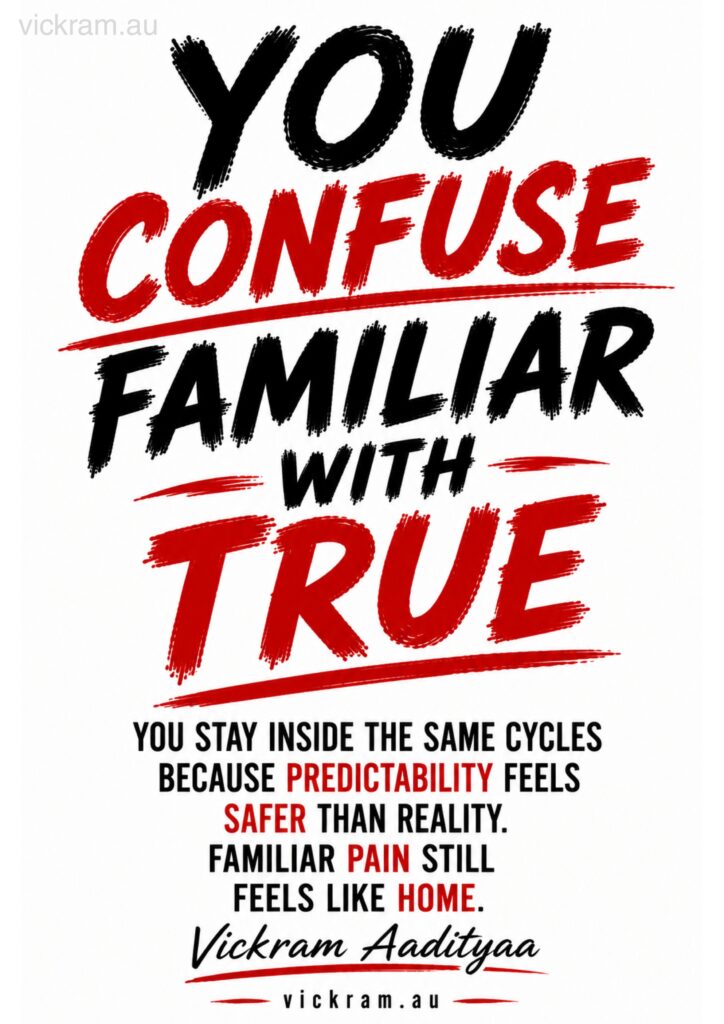
You Confuse Familiar With True

The Dismantling Project

The mind does not seek truth. It seeks pattern recognition. What it has seen before, it trusts. What it has not seen before, it resists. This is not a flaw. It is a mechanism built for survival.

The problem is that you are no longer in a survival situation, but the mechanism keeps running. You return to the same relationship dynamics not because they work. You return because they are recognisable. You stay in situations that cause you pain not because the pain is worth it. You stay because the pain is known. Known pain has a shape. Unknown freedom does not.

This is why change is difficult. Not because the new thing is worse. Because the new thing is unfamiliar. The mind reads unfamiliar as unsafe. It pulls you back to what it knows. It calls this protecting you. The cycle you keep repeating has a feeling. That feeling is home. Not because it is good. Because it is what was there when you first learned what home meant.

You have been recreating that original condition ever since, in different rooms, with different people, wondering why nothing changes. Familiar is not true. Familiar is just well-worn. You have walked the same internal path so many times that it no longer occurs to you to look for another one.

The groove is so deep that you call it your nature. What you have always done is not who you are. It is what you have always done. The difference matters.

The Dismantling Project poster on desire and reaction by Vickram Aadityaa.

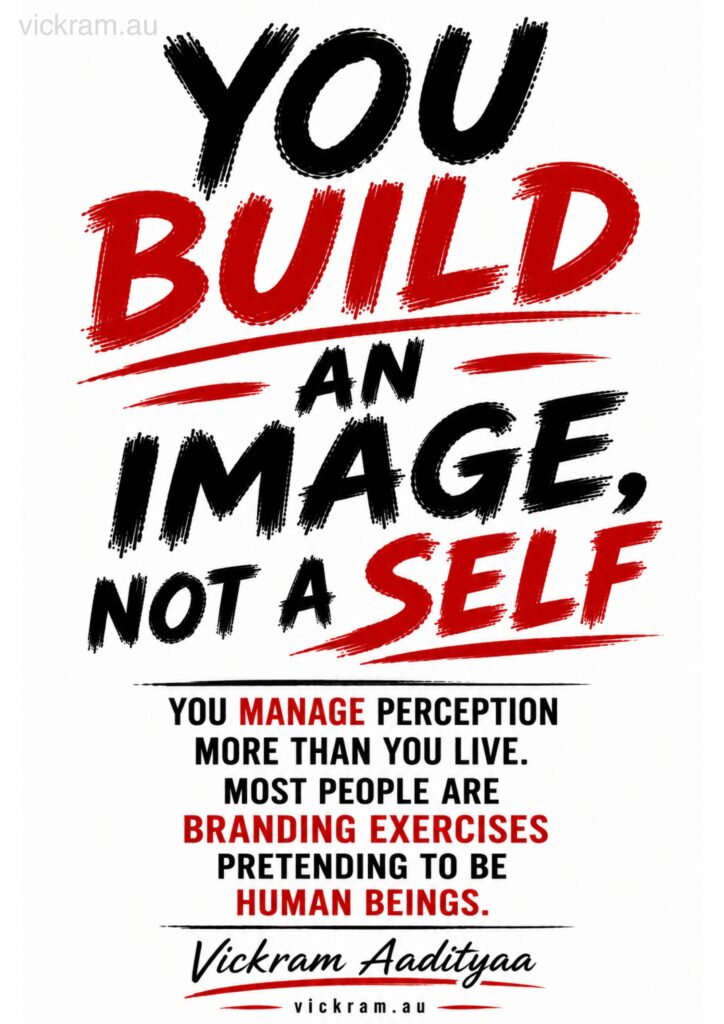
You Build An Image, Not A Self

The Dismantling Project

Look at how you spend your attention. Look at the decisions you make in a day. A significant portion of them are not about living. They are about how you appear to be living. What you post. What you say in rooms where it matters. What you wear to a meeting.

How you frame what happened to you in conversation. You are constantly editing the signal you send out. This is not vanity. Vanity is conscious. What you are doing is mostly automatic. The monitoring happens in the background without you deciding to activate it. You check the response before you have finished the action. You adjust before the adjustment is necessary.

The image is not a lie exactly. It is a selection. You choose which parts of yourself to show and which to keep out of sight. The parts kept out of sight do not disappear. They exist in the gap between who you appear to be and what you actually are. That gap takes energy to maintain.

Most people are running a branding operation on themselves at all times. They are not living. They are producing content about living. The documentation replaces the experience. The caption becomes more real than the moment. The self that would exist if you stopped managing the image is not something most people ever find out about. The management starts early. It becomes habitual.

By the time you are an adult, you cannot always tell the difference between what you actually think and what you have decided it is safe to think in front of other people.

The Dismantling Project poster on assembled identity by Vickram Aadityaa.

You Are A Collection, Not An Individual

The Dismantling Project

You did not arrive at your opinions through independent reasoning. You absorbed them. The music you love was introduced to you. The food you prefer was placed in front of you at a formative age. The political position you hold was shaped by who raised you, who you spent time with, what you were afraid of, and what you were rewarded for saying. This does not make you a fraud. It makes you human.

Humans are porous. We take in what surrounds us. The problem is not the absorption. The problem is mistaking the absorbed material for original thought. The person you call yourself is largely a sediment of influences. Family. Culture. Schooling. Peers. Media. Fear. Desire. Each left a layer. The layers compacted. You call the result your personality, your values, your identity.

But if you trace any of it back far enough, you find something external at the origin. This matters because most of the things you feel most strongly about, you feel strongly about for reasons you did not choose. The conviction is real. The origin of the conviction is not yours. None of this means your values are wrong or your preferences are invalid. It means they are not entirely yours in the way you assume they are.

There is a difference between living by values you have examined and living by values you absorbed and then stopped questioning. Most people are doing the second thing and calling it the first.

The Dismantling Project poster on desire and reaction by Vickram Aadityaa.

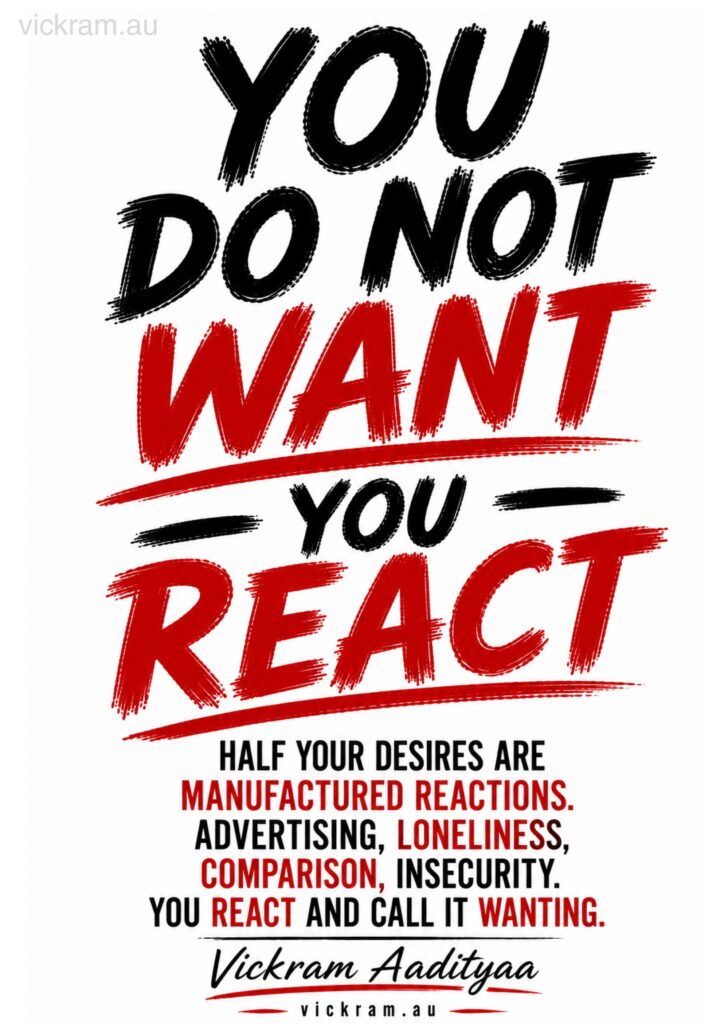
You Do Not Want – Your React

The Dismantling Project

Desire does not arise from nowhere. It is produced. An image is placed in front of you. A lack is identified. A solution is provided. You feel the want before you have decided to want anything. By the time you notice the wanting, the mechanism has already run. Advertising does this professionally. But advertising is only the most visible layer. Loneliness produces desire. Insecurity produces desire. Comparison produces desire.

The gap between where you are and where you see others being produces desire. You react to a perceived deficit and call the reaction a want. This is not about whether the things you want are good or bad. It is about the question of origin. When you say you want something, it is worth pausing long enough to ask where the want came from. Was it there before you saw it? Did it arise from inside, or did it enter from outside and settle in so quickly that you could not tell the difference?

Most desire is a response to something. A trigger. A comparison. A fear of being left without. The wanting feels internal because it is happening inside you. But the conditions that produced it were external. The person who knows what they actually want, stripped of conditioning and reaction and comparison, is rarer than most people assume.

Most people know what they react to. They have mistaken reaction for desire their whole lives. When the trigger changes, the want changes. That is not wanting. That is responding.

The Dismantling Project poster on borrowed ambition by Vickram Aadityaa.

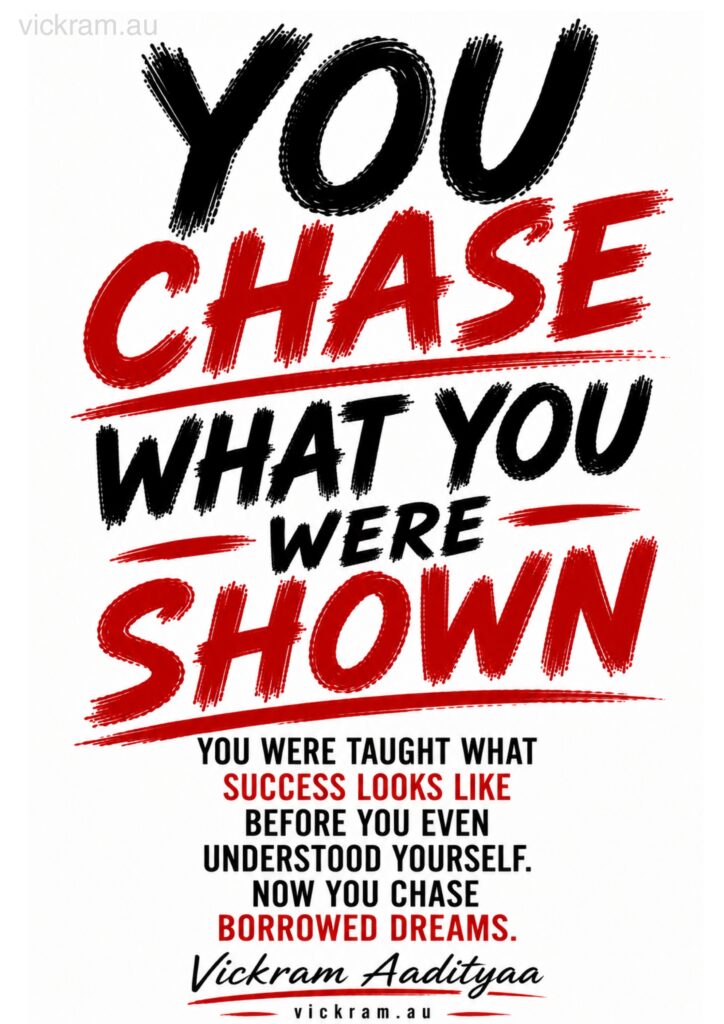
You Chase What You Were Shown

The Dismantling Project

Before you understood yourself well enough to know what you wanted, you were shown what success looked like. A specific kind of house. A specific kind of job. A specific kind of relationship. A specific amount of money that meant you had made it. The images were given to you before you had the ability to evaluate them. You have been chasing those images ever since.

Not because they suit you. Because they were installed early, and early installation goes deep. The target feels like yours because you have been moving toward it for so long. But it was placed there by someone else, in a different time, for reasons that had nothing to do with who you actually are.

This is why people arrive at what they worked for and feel nothing. Or feel wrong. They achieved the destination that was handed to them and discovered it did not fit. The ambition was borrowed. The achievement is real. The satisfaction is absent. You cannot fill a shape that was not made for you. You can reach it. You can stand inside it. It will not feel like home.

The harder work is not reaching the destination. The harder work is questioning whether the destination was ever yours to begin with. Most people never do this. The chase is so total, so consuming, that stopping to ask whether the direction is right feels like failure. So they keep moving. They call it drive. They call it ambition. Sometimes it is.

Sometimes it is just a very determined form of not asking the question.

The Dismantling Project poster on attention and connection by Vickram Aadityaa.

You Confuse Attention With Attraction

The Dismantling Project

Being noticed is not the same as being valued. Being desired is not the same as being known. Being popular is not the same as being loved. These distinctions collapse early because attention and genuine connection can feel similar from the inside. Both produce a response in the body. Both reduce the feeling of being alone. The confusion runs deep.

People spend enormous amounts of energy making themselves visible. Crafting the profile. Performing the version of themselves most likely to produce a response. Getting the response. Feeling, briefly, less alone. Then needing more. What is being fed by attention is not the part that needed feeding. Visibility soothes the surface. It does not reach what is underneath.

The part that is actually hungry is the part that wants to be seen without the performance. Known without the curation. Accepted without the editing. That kind of connection requires exposure. Not performance, but exposure. Showing what is actually there, not the version most likely to produce approval. Most people have not done this. Most people do not know how. T

he performance started so early that the boundary between performance and self is difficult to locate. So the loop continues. More visibility. More attention. The feeling of being seen without the reality of it. The hunger that does not decrease no matter how much attention arrives, because attention was never what the hunger was for.

You can be the most visible person in a room and still be completely alone in the way that matters.

The Dismantling Project poster on anticipation and addiction by Vickram Aadityaa.

You Are Addicted To Anticipation

The Dismantling Project

The notification arrives and something happens in the body before you have even read what it says. The possibility of the message is already producing a response. This is the mechanism. Not the content. The possibility of content.

Anticipation is a drug in the literal sense. It produces a neurochemical response. The brain releases something in the gap between not knowing and knowing. The moment of resolution, the actual event, is often less powerful than the waiting. This is why the chase feels better than the having. Why the potential is more alive than the reality.

You have structured large parts of your life around maintaining this state. The unresolved conversation. The pending outcome. The thing that might happen. You hover in the gap between not knowing and finding out, and you call this living. But you are not living in those moments. You are waiting.

The phone is a delivery mechanism for this. So is the unfinished pursuit. The person you have not quite secured. The deal not yet closed. The result not yet in. You are most alive, most focused, most present when you are waiting to find out. When you find out, the charge dissipates.

You look for the next thing to wait for. This is not excitement. Excitement is brief. What you have is a structural dependency on unresolved outcomes. The resolution itself is almost a disappointment. It collapses the anticipation, and the anticipation was the whole point.

What would it mean to be present in a moment that is already complete? That is the question most people never sit with long enough to answer.

The Dismantling Project poster on seeking completion through others by Vickram Aadityaa.

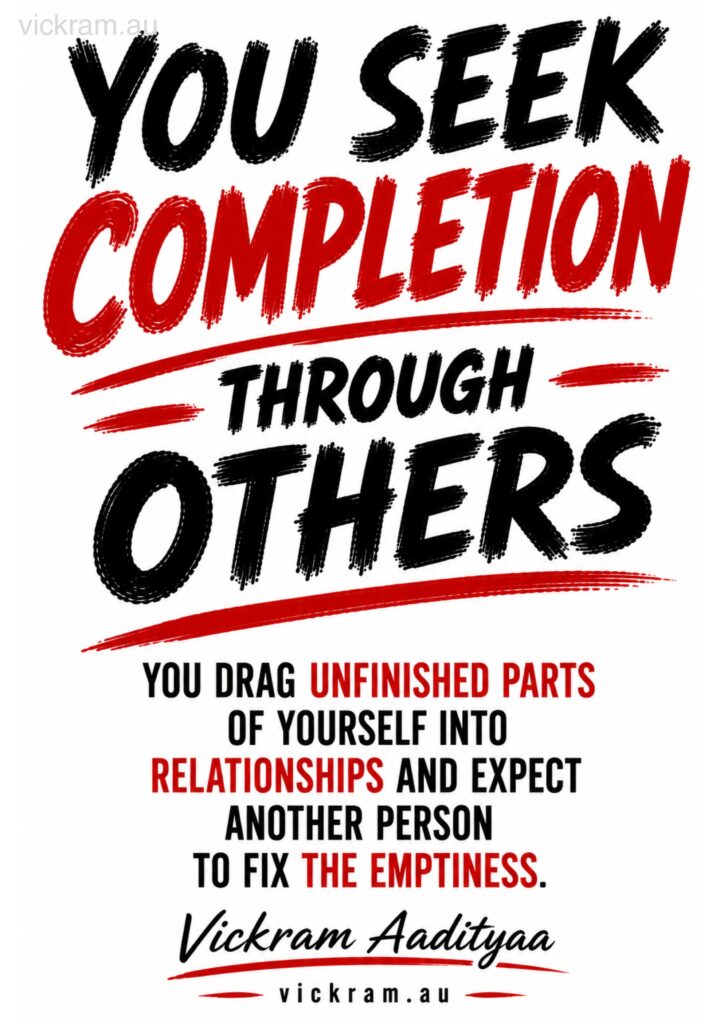
You Seek Completion Through Others

The Dismantling Project

You entered relationships carrying unfinished material. Wounds that did not close. Needs that were not met. Parts of yourself that were not seen or accepted or allowed. You brought all of that to another person and, beneath the surface of everything else, you wanted them to fix it. This is not unusual. This is the norm.

Most people enter relationships in an incomplete state and look for the other person to complete what is missing. The attraction itself is often structured around this. The person who draws you toward them is often the person who, in some way, mirrors the original wound. You are not looking for a partner. You are looking for a resolution. The relationship cannot provide it.

Not because the other person is insufficient. Because no other person can finish something that is yours to finish. The wound belongs to you. The incompleteness belongs to you. Another person can be present with you in it. They cannot resolve it for you. When the relationship fails to do what you needed it to do, the common response is to find a different person. One who might do it better. The same template runs. The same unmet need looks for the same unavailable resolution. The relationship changes. The dynamic does not.

The work is not finding the person who will complete you. The work is understanding what in you believes it needs completing, and why. That is interior work. It has no substitute. No relationship can do it. No amount of being chosen or desired or loved can reach the place where the incompleteness lives.

The Dismantling Project poster on compulsion and passion by Vickram Aadityaa.

You Call Compulsion Passion

The Dismantling Project

Compulsion and passion can look identical from the outside. Both produce intensity. Both produce focus. Both produce a kind of devotion to a single thing. The difference is not in the behaviour. It is in what is driving it. Passion moves toward something. Compulsion moves away from something.

The person who is genuinely drawn to their work moves toward it because it calls to them. The person running on compulsion moves toward it because stopping would expose what they are running from. The work is the same. The interior condition is entirely different.

Obsession is often presented as admirable. You hear about the hours put in. The sacrifices made. The total commitment. What you do not hear about is what the person cannot do without the obsession. What collapses when it stops. Whether they have ever been still long enough to find out.

Attachment is not love. Attachment is need dressed in the language of love. Real love can survive distance, interruption, uncertainty. Attachment panics when the object of attachment is not available. The panic is the tell. If you cannot let go of something without distress, you are not passionate. You are dependent. The thing is not feeding you. It is holding you.

The distinction matters because you cannot see clearly from inside a compulsion. You can only see the object of it. Everything else goes out of focus. What would remain of your drive if you removed the thing you were running from?

The Dismantling Project poster on managing perception by Vickram Aadityaa.

You Try To Manage Perception

The Dismantling Project

The conversation happens in real time. But in your head, it is already being edited. Before you finish a sentence, part of you is watching how it lands. Adjusting the next one based on the response. Monitoring the face of the person you are talking to. Reading for signs of approval or disapproval. Modifying accordingly.

You rehearse things before they happen. You replay them after. You think about what you should have said. You construct better versions of yourself in hindsight. You run imaginary conversations that never happen in the rooms they are imagined in. The audience for all of this is not always clear. Sometimes it is specific.

A person you are trying to impress or appease or avoid disappointing. Sometimes the audience is abstract. A general sense of how you are being perceived by the world, by history, by people who are not there and may not care. The monitoring is exhausting precisely because it never turns off. You are performing for a crowd that exists largely in your own mind. You are managing a perception that most people around you are too busy managing their own perception to actually form.

The energy spent on this is not trivial. It is a significant portion of the attention available to you. Spent not on what is in front of you, but on how what is in front of you reflects back on the image you are trying to maintain. What would it feel like to be in a room with no monitoring running?

The Dismantling Project poster on rehearsal and presence by Vickram Aadityaa.

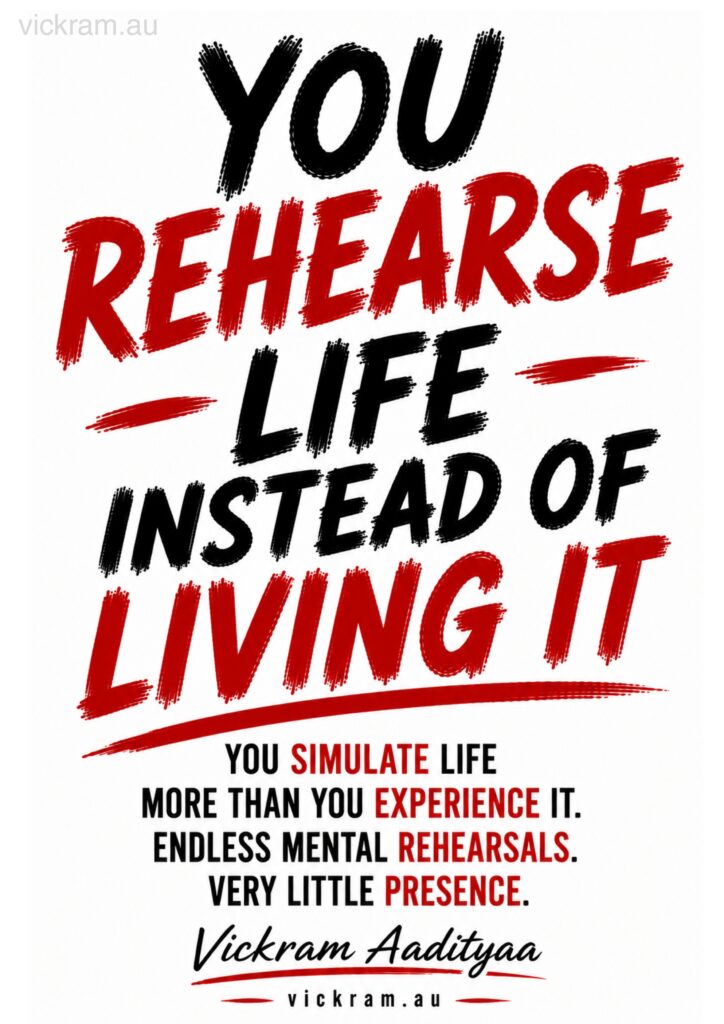
You Rehearse Life Instead Of Living It

The Dismantling Project

A significant portion of your inner life is not experience. It is simulation. You run through what might happen. You prepare for conversations that may not occur. You build scenarios and populate them with outcomes. You process events before they exist and after they have passed.

The present moment, the one actually in front of you, is often the least inhabited of the three. This is not planning. Planning has a specific outcome and a specific purpose. What you are doing is more diffuse. It is a continuous simulation of living. You are in the meeting, but also already preparing for what you will say about the meeting later. You are with the person, but also watching yourself being with the person. The simulation feels productive. It feels like engagement. But you can simulate for years and not move.

The rehearsal is not the action. The mental preparation is not the conversation. The internal processing of the event is not the event. There is a quality of experience that is only available in unmediated contact with what is actually happening. Not through the layer of commentary and preparation and review. Not through the narrative you are building about it. In it.

That quality is largely absent from a life lived primarily in simulation. You have spent a great deal of time preparing to live. The preparation does not expire. You arrive at one rehearsal having left another.

The actual performance, the moment where you are simply present with no layer between you and it, is rarer than you think.

The Dismantling Project poster on anticipatory fear by Vickram Aadityaa

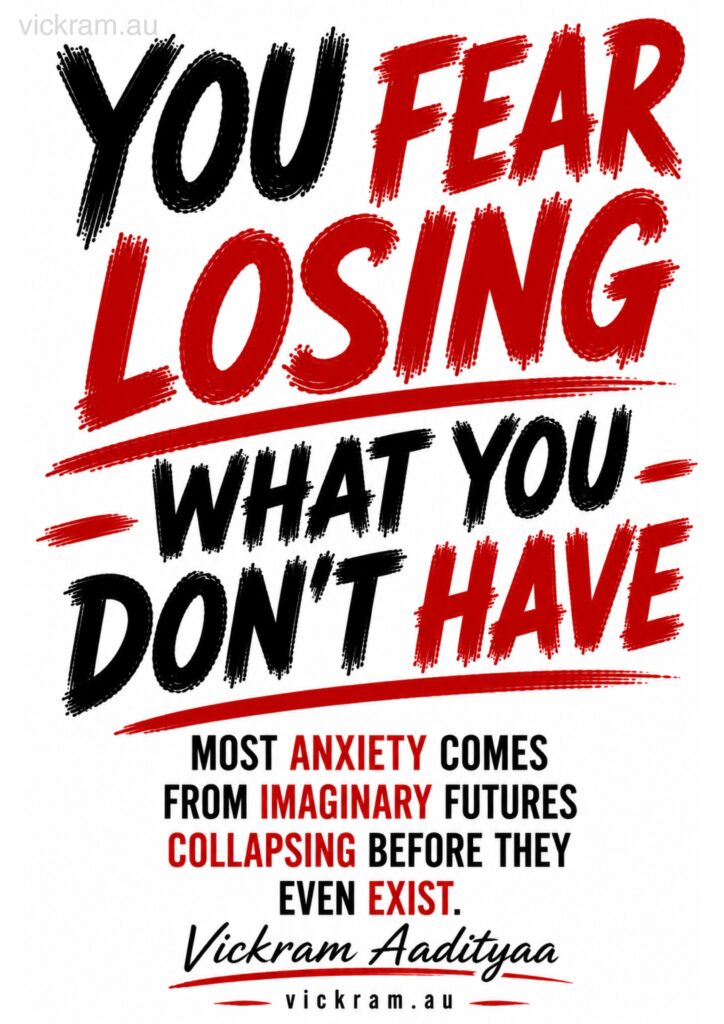
You Fear Losing What You Do Not Have

The Dismantling Project

The anxiety is real. The object of the anxiety often is not. You are afraid of something collapsing that has not been built. You are grieving something you have not yet had. You are protecting a future that exists only in the version of events you have constructed in your head. This is one of the primary sources of human suffering that has no external cause.

The loss has not occurred. The danger has not arrived. But the mind runs the scenario in which it does, and the body responds to the scenario as though it is happening now. The cortisol does not know the difference between an actual threat and an imagined one. It responds to both. You guard the potential relationship as though it is already yours and already under threat.

You worry about failing at the thing you have not yet attempted. You experience the end of something before it has started, and the experiencing of the ending stops you from beginning. The imaginary future demands as much energy as the real present. In some cases, more. Because the imaginary future has no actual information in it. It is built entirely from projection. And projection tends toward the worst available outcome, because the worst available outcome is what the threat-detection system is designed to find.

Nothing you are protecting in these moments exists. The grief is real. The threat is constructed. Somewhere underneath it is the question of whether you can tolerate not knowing what happens next. Most people cannot. So they simulate the loss in advance. Call it preparation. It is not preparation. It is pre-suffering.

The Dismantling Project poster on holding on and stability by Vickram Aadityaa.

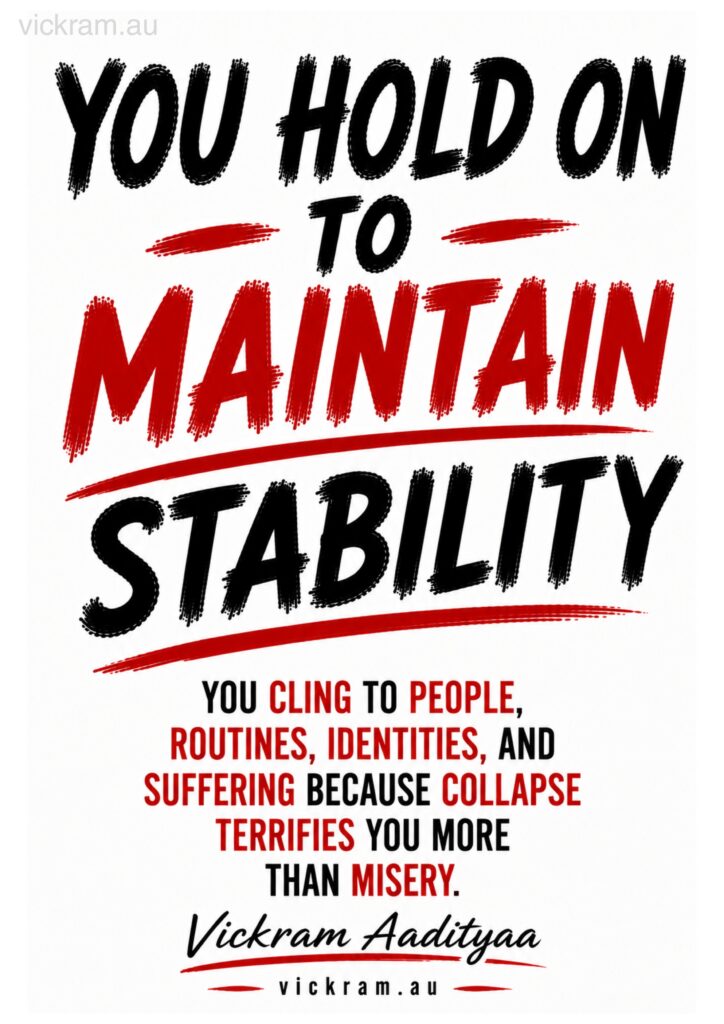
You Hold On To Maintain Stability

The Dismantling Project

There are things in your life you already know are finished. Relationships that have run their course. Versions of yourself that no longer work. Identities built for conditions that no longer exist. You know this. You hold on anyway. The holding on is not about the thing. It is about what letting go would expose.

If you release the relationship, you have to feel what is underneath it. If you drop the identity, you have to find out what is there without it. If you stop the pattern, you enter the unknown. The unknown is more frightening than the known pain. So you stay. Misery has the advantage of familiarity. You know its contours. You know how to function inside it.

You have built a life around it without realising you have built a life around it. The suffering is not incidental. It has become structural. It is holding things in place. This is why the instruction to simply let go is useless. Letting go is not an act of will. It is the result of understanding why you are holding on. And most people are holding on because the alternative is an open space they do not know how to be in.

Collapse is more frightening than misery. So misery continues. The stability you are protecting is not stability. It is stasis dressed as stability. Nothing is growing. Nothing is moving. You are not safe. You are held in place by the weight of what you will not release.

What would you need to believe about yourself to let it go?

The Dismantling Project poster on control and safety by Vickram Aadityaa.

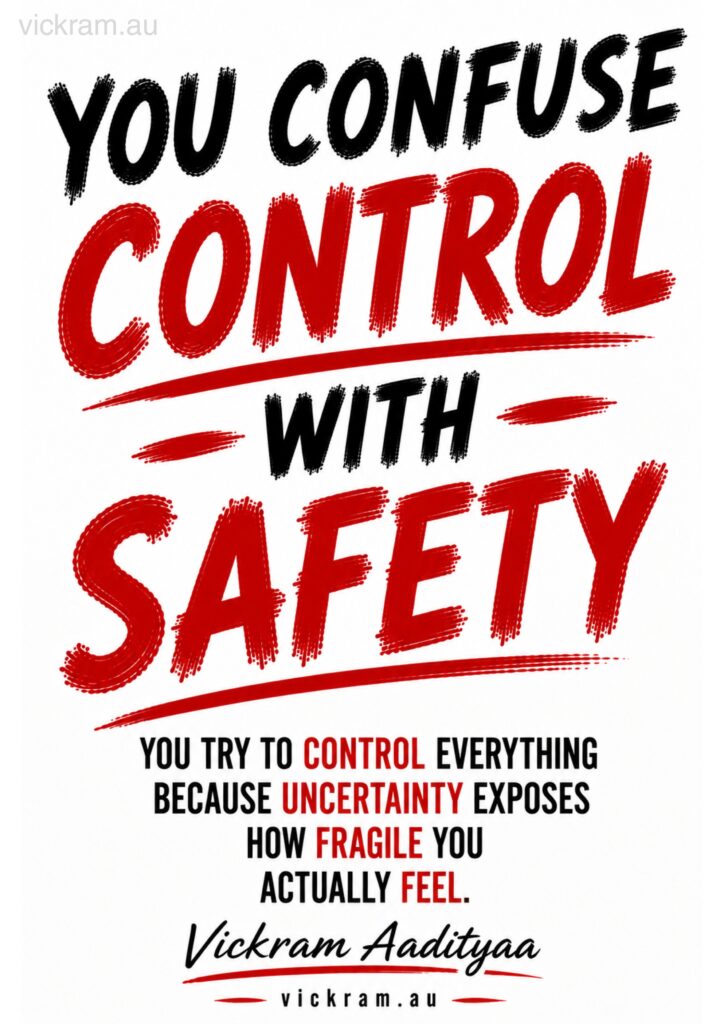
You Confuse Control With Safety

The Dismantling Project

Control is the response to a specific kind of fear. Not fear of something external. Fear of your own interior. Fear of what you might feel if the structure loosened. Fear of what you might find if the noise stopped. Control is how you prevent yourself from having to find out. You manage the schedule. You manage the environment. You manage the people around you, sometimes directly, often through more subtle means.

You manage information. You control what you allow yourself to think about. All of this produces the sensation of safety. The sensation is not safety. It is the temporary suppression of uncertainty. Uncertainty does not go away because you have controlled the conditions. It waits. And the more you control, the more sensitive you become to the things you cannot control.

Each element of unpredictability becomes a threat. The system that was supposed to produce safety produces vigilance instead. You are not safer. You are more fragile. Real safety, if it exists, is not structural. It is not produced by controlling the environment. It is an interior condition. The ability to be in uncertainty without being destroyed by it.

To not know what happens next and remain intact. Most people who are running heavy control systems have never experienced this. They have only experienced the absence of it when the control fails. You are not afraid of the thing you are controlling for. You are afraid of who you would be if you stopped controlling.

That person, the one who exists in the uncontrolled state, is what you have been keeping from yourself.

The Dismantling Project poster on resistance and reality by Vickram Aadityaa.

You Resist What Is Already Happening

The Dismantling Project

Reality does not wait for your consent. It moves. Events occur. Situations change. People leave. Things end. Things you did not want arrive. Things you wanted do not. Reality has no investment in matching your preferences. It is indifferent to the story you are telling about what should be happening.

The resistance is not an intervention. You cannot stop what is already in motion by refusing to accept it. The resistance is a position you take inside yourself in relation to what is happening. It changes nothing in the external situation. It changes everything in your internal one.

When you resist what is already happening, you split your experience. Part of you is in the situation. Part of you is fighting the situation. That second part is not present. It is arguing with reality. It is holding a position against something that has already occurred. The cost of maintaining that position is enormous and continuous. This is different from changing things.

Changing things requires being in contact with reality as it is. Resistance takes you out of contact. You cannot act clearly from inside a refusal to see what is in front of you. The first step in changing a situation is accepting that the situation is what it is. Not accepting that it is good. Not accepting that it should stay. Accepting that it is real.

The suffering that comes from resistance is not caused by the event. It is caused by the ongoing argument with the event. The event happened once. The argument continues for as long as you run it.

The Dismantling Project poster on clarity and avoidance by Vickram Aadityaa.

You Fear Seeing Clearly

The Dismantling Project

Clarity is not neutral. It costs something. When you see clearly, you also see what needs to change. You see where you have been dishonest. You see what you have been avoiding. You see the gap between who you say you are and what you are actually doing. Clarity does not leave you with your story intact. This is why most people do not pursue it. Not because they are incapable. Because they already sense what it would show them, and they are not ready to look.

The avoidance is not ignorance. It is a choice. A pre-emptive defence against a truth that would be uncomfortable to hold. You have constructed an explanation for your situation that protects you. The explanation is not entirely false. It is selectively true. It includes the parts that position you well and omits or softens the parts that do not. You live inside this explanation. It becomes your reality because you have stopped questioning it.

Seeing clearly means dropping the explanation. Not replacing it with a worse one. Dropping it and looking at what is there before the interpretation. Most people cannot sustain this for more than a moment. The interpretation snaps back immediately. It has to. Without it, the image of yourself you have built requires revision.

Comfortable lies are not passive. They are actively maintained. Every time clarity arises and you look away, that is a choice. It is a choice most people make dozens of times a day without noticing.

The cost is the gap between where you are and where you could be if you were willing to see it.

The Dismantling Project poster on avoidance and being stuck by Vickram Aadityaa.

You Avoid Discomfort And Stay Stuck

The Dismantling Project

The phone comes out in the moment before discomfort arrives. The scroll begins before the feeling can fully form. The drink. The work. The planning. The conversation. The food. Each of these functions as an interruption of something the body was about to feel. You have become so efficient at this that the interruption is now nearly instantaneous.

The discomfort barely registers before the numbing is already running. This is not weakness. It is the logical outcome of living in an environment designed to offer an exit from every interior state. The exits are always available. The interior states, if left alone, would complete. They would arrive, be felt, and pass. But you do not leave them alone. You interrupt them. And an interrupted feeling does not resolve. It waits.

The accumulation of interrupted, unprocessed feeling is what you call being stuck. Not in your circumstances. In yourself. The circumstances often could move. You cannot, because you are carrying everything you refused to feel. It takes up the space that movement would require. Nothing changes if you cannot be with what the change would feel like.

Every exit from discomfort is an exit from the information the discomfort contains. That information is about where you actually are, what you actually need, what is actually not working. Without it, you are navigating without data. The discomfort is not the problem. It is the signal. The numbing is the problem.

And the numbing works well enough in the short term that most people never find out what they were numbing over.

The Dismantling Project poster on vulnerability and being seen by Vickram Aadityaa.

You Are Afraid Of Being Seen

The Dismantling Project

You want to be known. You also want to control what is known. These two things are not compatible. Real knowing requires exposure. Not the exposure of a curated reveal, where you decide what to show and when. Exposure of the unedited version. The parts that are not working. The fears that are not rational. The contradictions you have not resolved.

The desires you are not proud of. Most people have never shown that to anyone. They have shown approximations. Versions. Edited highlights of their interior life. They have been vulnerable in the ways that are socially legible and safely received. The deeper material stays hidden. Not because no one asks. Because the risk of showing it and having it rejected is more threatening than the pain of keeping it hidden. This is the bind.

You are lonely at a level that connection through performance cannot reach. The connection you want requires you to be seen at the level you are hiding. But being seen at that level requires a trust you have not built, or a courage you have not found, or a belief that what is there is not too much for someone else to hold.

Most people resolve this bind by staying at the surface and calling it connection. They maintain the performance and tell themselves it is because others could not handle the real version. Often it is because they cannot handle the possibility that they might be right. You want to be known. But you are more afraid of being known and found insufficient than you are of not being known at all.

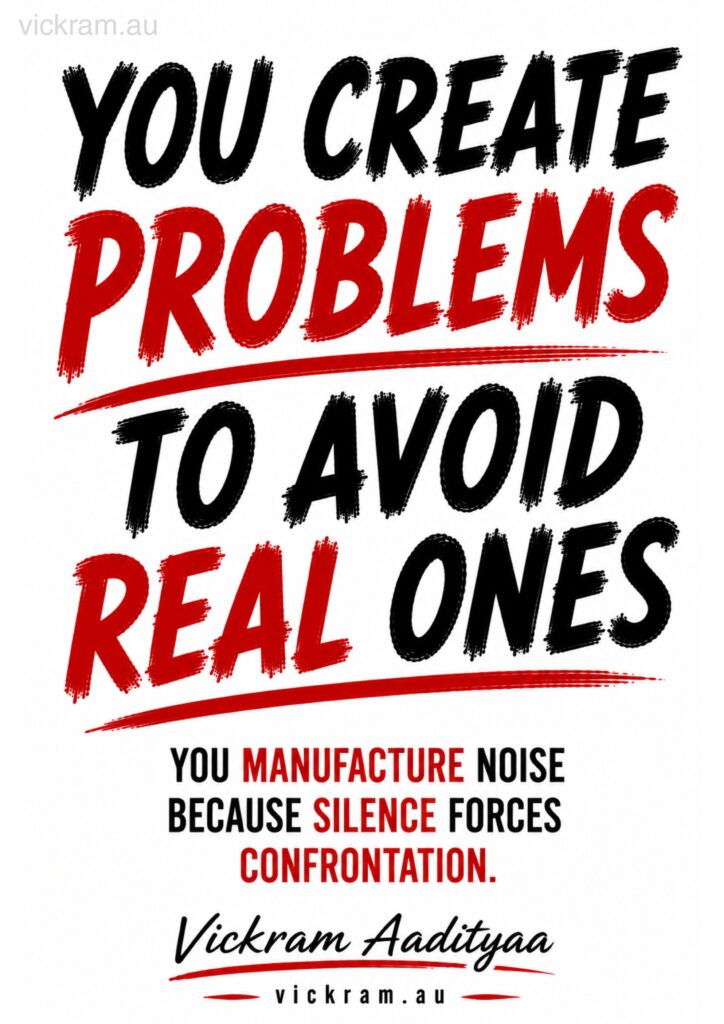
You manufacture noise to keep the real problem out of view. Silence would show you what you are actually avoiding.

You Create Problems To Avoid Real Ones

The Dismantling Project

There is a problem you are not dealing with. It sits underneath the activity. Underneath the busyness. Underneath the complaints about smaller things. You can feel it when the noise drops below a certain level. So you keep the noise up. The manufactured problem has a useful quality. It is addressable. It has a concrete shape. It produces urgency without requiring you to go anywhere uncomfortable.

You can spend hours on it. Days. You can feel productive. You can feel like you are dealing with something. The actual problem remains untouched. This is not always conscious. The noise does not always feel chosen. The distractions arrive and you follow them, and it is only in the rare moments of stillness that you notice the thing underneath.

You notice it and then find the next thing that needs your attention. The noticing gets buried again. Silence has a specific function in this. Silence removes the cover. It creates the conditions in which whatever is being avoided becomes visible. This is why most people are uncomfortable with silence. Not because silence is unpleasant. Because silence is revealing.

In silence, you find out what you have been carrying. The problem you are avoiding is not always large. Sometimes it is a conversation you have not had. A decision you have been deferring. A feeling you have not allowed. The avoidance is always larger than the avoided thing.

The energy spent keeping it out of view costs more than addressing it would. You already know what it is.

The Dismantling Project poster on pain as identity by Vickram Aadityaa.

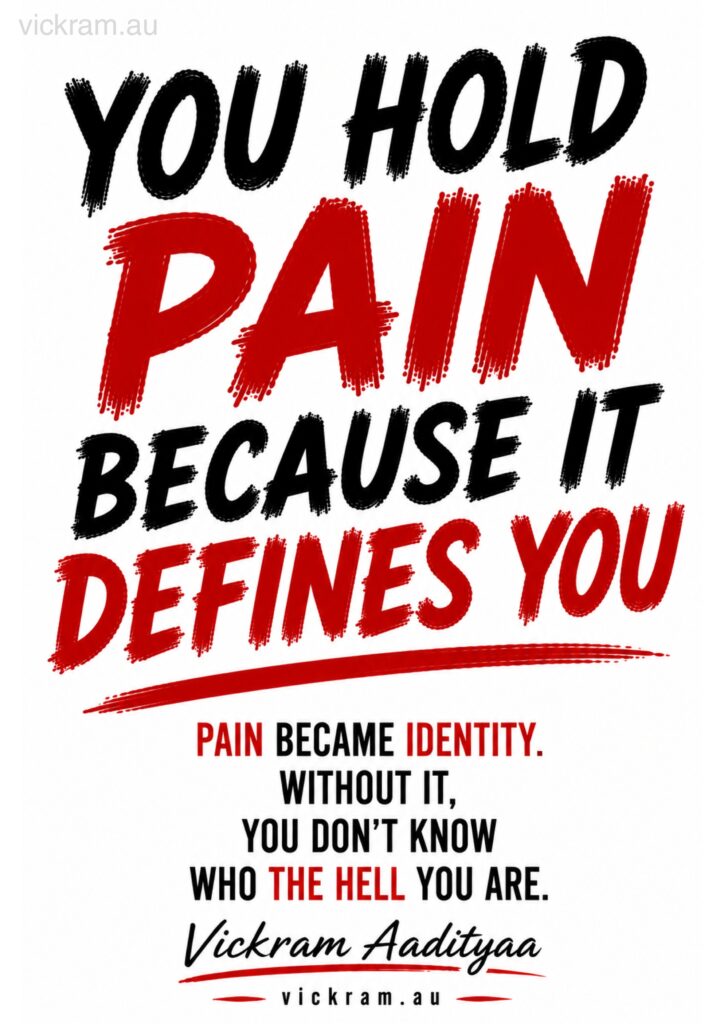
You Hold Pain Because It Defines You

The Dismantling Project

At some point, the pain stopped being something happening to you and became something you are. This is a gradual process. No one decides to make suffering their identity. It accretes. The story gets told enough times that it solidifies. The wound becomes the central organising fact of the self. You know who you are in relation to what happened to you. The story of what happened to you explains your current situation. It explains why certain things are not possible for you.

Why certain behaviours make sense. Why you deserve particular treatment or particular understanding. The pain is not just a memory. It is a structure. The structure is useful. It provides continuity. It provides explanation. It provides, in some relationships, a claim on the care and patience of others. Releasing it would mean releasing the explanation. It would mean being responsible, in a new way, for who you are going forward.

Without the story, the question of who you are becomes open again. This is not a judgment. This is how the psyche works when it encounters overwhelming experience. It builds around the wound. The building is necessary. The problem arises when the building becomes permanent and the wound becomes load-bearing.

If you do not know who you are without the pain, that is important information. Not about the pain. About the work that has not yet happened. The pain was real. What happened was real.

The question is whether the version of you that was built around it is who you are now, or who you became in order to survive then.

The Dismantling Project poster on fear of letting go by Vickram Aadityaa.

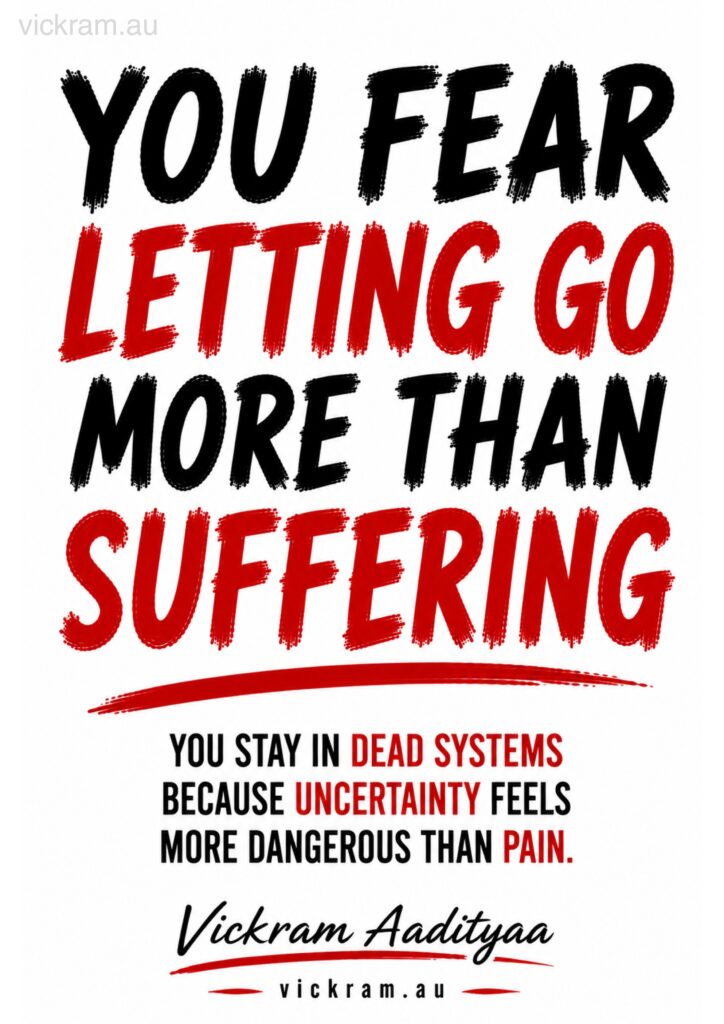
You Fear Letting Go More Than Suffering

The Dismantling Project

You know what is not working. You have known for some time. The relationship, the job, the belief, the habit, the version of events you keep returning to. It is not working and you know it is not working and you stay anyway. The reason given is usually practical. The timing is not right. The conditions need to be different before you can move. You need more certainty before you can let go.

These reasons are not entirely false. But they are also not the primary reason. The primary reason is that staying, even in something that causes damage, is less frightening than the open ground on the other side of leaving. Known suffering has a shape. You know how to function inside it. You have built workarounds. You have learned its rhythms. The suffering is real, but it is predictable.

What comes after letting go is not predictable. It is uncertain in ways that the mind reads as dangerous. The danger is not in the new situation. The danger is in who you would have to become to be in it. Letting go often requires relinquishing not just the situation but the identity that was built in relation to it. You are not just holding onto the relationship. You are holding onto the version of yourself that exists inside it.

This is why people stay past the point that is good for them. Not because they do not see the damage. Because the damage is familiar and the alternative is unknown.

The unknown requires a self that can tolerate not knowing. That self has not yet been found.

The Dismantling Project poster on external searching and internal avoidance by Vickram Aadityaa.

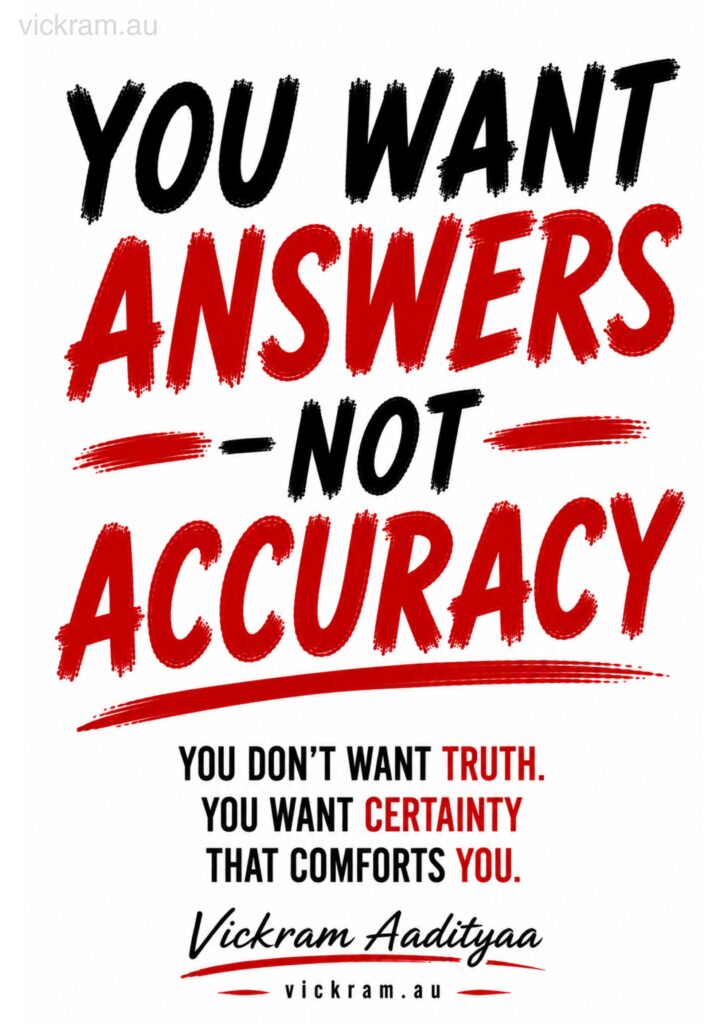
You Want Answers, Not Accuracy

The Dismantling Project

You are not looking for truth. You are looking for certainty that confirms the position you have already taken. This is not a character flaw. It is how cognition functions under conditions of uncertainty. The mind wants resolution. It will accept a false resolution over continued openness because openness is uncomfortable and false resolution at least produces the sensation of knowing.

You search for information in the way that produces agreement, not the way that produces accuracy. You find the sources that confirm. You read until you find the thing that says what you already believed. You call this research. It is not research. It is the documentation of a conclusion you had already reached.

Real inquiry is uncomfortable because it does not know where it will end. It might end in a place that requires you to change your position. To revise your understanding of a situation you had decided you understood. To hold complexity where you wanted simplicity. Most people stop before this point. They stop at the edge of genuine uncertainty and return to the position that was already there.

Accuracy often produces no usable feeling. It is neutral. It is cold. It does not offer comfort. Certainty offers the feeling of ground beneath your feet even when the ground is not actually there.

You choose the feeling over the reality so reliably that you have started calling the feeling reality. The cost of this is not abstract. The decisions you make from false certainty produce outcomes in the real world.

The relationships you misread. The situations you misunderstood. The version of events you chose because it was easier to hold.

The Dismantling Project poster on external searching and internal avoidance by Vickram Aadityaa.

You Search Outside To Avoid Looking Inside

The Dismantling Project

The search has been going for a long time. New systems. New teachers. New frameworks. New practices. Each one carries the possibility that this is the one. The one that will finally resolve what has not been resolved. You approach each with real investment. Some of them help, partially. None of them finish the job. So the search continues. The search is not bad.

The problem is the function it is serving. Every time you look outside, you are not looking inside. Every time you find a new method to follow, you defer the more difficult work of sitting with yourself without a method. The search is productive enough, credible enough, to serve as a permanent alternative to stillness. What you are looking for outside is a map. A set of instructions. A person or a system that can tell you what to do with what is inside you.

But the interior does not work that way. It cannot be navigated by someone else’s map. The map was drawn for someone else’s territory. Your territory has different features. The answer to what is inside you will not be found outside you. It will not be found in the next book. The next retreat. The next relationship. The next philosophy. These things can create conditions. They cannot do the work.

The work is you, sitting with yourself, without the search as an exit route. Most people have everything they need to begin. What they are missing is not more information. It is the willingness to stop collecting information and use what they already have.

The search will continue as long as stopping the search feels worse than not having the answer.

The Dismantling Project poster on knowledge and clarity by Vickram Aadityaa.

You Collect Knowledge, Not Clarity

The Dismantling Project

You know more than you ever have. More frameworks. More models. More information about psychology, behaviour, systems, history. You can explain the patterns. You can name the mechanisms. You have the vocabulary for what is happening. And yet nothing changes. The pattern you can explain you still repeat. The wound you can name is still there.

The behaviour you understand in precise psychological terms is still running. The knowing has not become doing. The information has not become transformation. This is not a gap in knowledge. It is a different problem entirely. Understanding is not the same as change.

You can understand your attachment style in complete detail and still attach in the same way. You can know exactly why you avoid conflict and still avoid it. The knowledge sits in one place. The behaviour runs from another. Clarity is not more understanding. Clarity is contact with what is actually happening in you right now. It is not conceptual. It is immediate. It does not require vocabulary. It requires presence. And presence is what the collecting of knowledge often replaces.

You read about sitting with discomfort instead of sitting with it. You study the theory of presence instead of being present. The study becomes the practice. But study and practice are not the same thing. You can read about water your whole life and still not know what wet feels like. The collection grows. The clarity does not.

At some point the size of the library becomes its own form of avoidance. You are very knowledgeable about the thing you are not doing.

The Dismantling Project poster on meaning-making by Vickram Aadityaa.

You Turn Everything Into Meaning

The Dismantling Project

Something happens. Before the event has finished arriving, the mind is already turning it into a story. Assigning cause. Finding pattern. Drawing conclusion. Placing it in relation to other events. Building a narrative that explains why this happened and what it means and where it fits in the larger arc of your life.

The narrative is not an accident. It is a defence. The raw event, uninterpreted, is too open. It sits there without edges. It does not tell you what to do next. The story gives it edges. It gives it a place in the sequence of events you call your life. It makes it manageable.

Randomness is almost intolerable to the human mind. The idea that something happened for no reason, that it fits no pattern, that it means nothing, produces a specific kind of anxiety that most people will do almost anything to avoid. So meaning is applied. Even to events that clearly do not carry it. Even to coincidences. Even to accidents. Even to the neutral.

The story you build becomes the thing you live inside. Not the event. The interpretation. You suffer from the interpretation more than the event in most cases. The event was brief. The story about the event, what it says about you, what it predicts, what it means, runs indefinitely.

You are a meaning-making machine operating in a universe that does not produce meaning. The meanings are yours. They are not in the events.

Seeing that clearly changes the relationship to the story. Not by removing it. By seeing it as yours to hold or put down.

The Dismantling Project poster on systems and freedom by Vickram Aadityaa.

You Want A System To Follow

The Dismantling Project

Every self-help framework, every spiritual tradition offered as a path, every productivity system, every set of rules for living well, succeeds because it offers the same thing. Relief from the burden of deciding for yourself. A set of instructions that, if followed, produces a result. Someone else has done the thinking. You follow the protocol. The appeal is not laziness. The appeal is the relief from uncertainty.

Genuine freedom, the kind that has no instructions, requires you to make decisions with incomplete information, for reasons you have to generate yourself, toward ends you have to define without a template. It requires you to be the source.

Most people are not comfortable being the source. So the system arrives and it is followed. And the system does some things. It produces some results. And then it meets something it was not designed for. Something specific to your situation, your interior, your particular configuration of wounds and needs and capacities. And the system does not have an instruction for that. And you either bend yourself to fit the system, or you look for a better system.

Freedom without a system means accepting that you might be wrong. That your choices are yours, including the ones that do not work. That you are responsible not just for following correctly but for choosing the direction. Most people find this more frightening than they expected when they first said they wanted freedom.

The system is not the problem. The problem is using it to avoid the question of who you are when you are not following anything.

The Dismantling Project poster on clarity and staying by Vickram Aadityaa. TAGS: Clarity, Avoidance, Insight, Presence, Change,

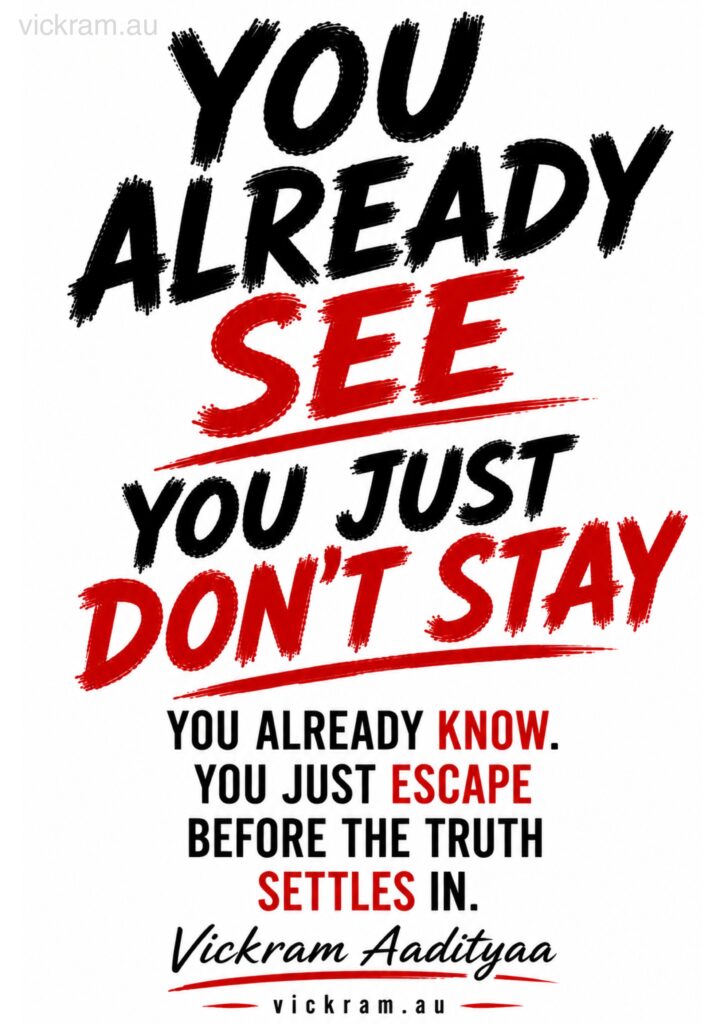
You Already See – You Just Do Not Say

The Dismantling Project

The truth arrives. You feel it. There is a moment of complete clarity in which you see exactly what is happening and why and what it would take to change. The moment is real. You are not imagining it. The seeing is accurate. And then something else arrives.

A thought. A distraction. A reason why now is not the right time. A memory of how it did not work before. A fear of what it would cost. The moment of clarity is replaced, within seconds or minutes, by the familiar noise. And you are back where you were. This happens more than you know.

The truth visits frequently. You have seen what you are doing in relationships, in work, in the patterns you repeat. You have seen it clearly, in moments that felt significant. The problem is not that you do not see. The problem is that you do not stay long enough for the seeing to change anything.

Staying requires something specific. It requires being willing to feel what the clarity produces. Because clarity produces feeling. It produces the feeling of what you have been doing and the cost of it. The feeling is not comfortable. The exit from clarity is also an exit from that feeling. And the exit is always available.

You do not need more insight. You need to stay with the insight you already have. To sit in the discomfort it produces without immediately finding a way out of it. The seeing is not the work.

Staying with what the seeing shows you is the work. Most people stop one step before that.

The Dismantling Project poster on what remains after dismantling by Vickram Aadityaa.

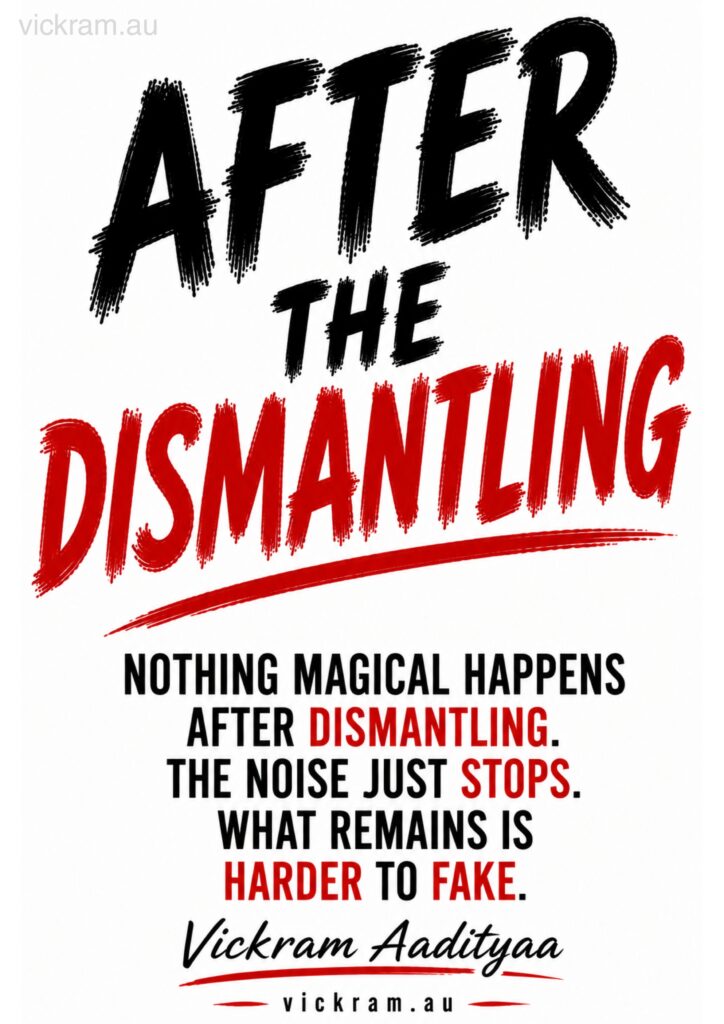
After The Dismantling

The Dismantling Project

You expected something to arrive. After the examination. After the stripping away of the stories and the identities and the mechanisms and the beliefs that were not yours. After all of that, there would be something. A realisation.

A clarity so complete it would reorganise everything. A version of yourself that was finally real. Nothing arrives. The noise stops. That is what happens. The internal commentary that was running continuously, the self-monitoring, the rehearsing, the defending, the explaining, the story about who you are and why, gets quieter. Or stops, in moments. And what is there without it is not dramatic. It is not transcendent. It is just what is there.

This is disappointing to most people. They wanted the dismantling to reveal something extraordinary underneath. A hidden self. A true nature. A core that had been buried under all the conditioning. There is no evidence that this exists in the way the metaphor suggests.

What the dismantling does is not reveal. It removes. It removes the noise. It removes the energy spent defending what was never yours. It removes the exhaustion of maintaining a performance. What remains is harder to fake because it has less material to work with. Less story. Less cover.

You cannot perform your way through the absence of the performance. You cannot construct an identity out of having dropped identity. The usual tools do not work in the space that the work creates.

What you do in that space, how you move, what you choose, what you value, that is not the end of the project. That is where the actual question begins.

Scroll to Top