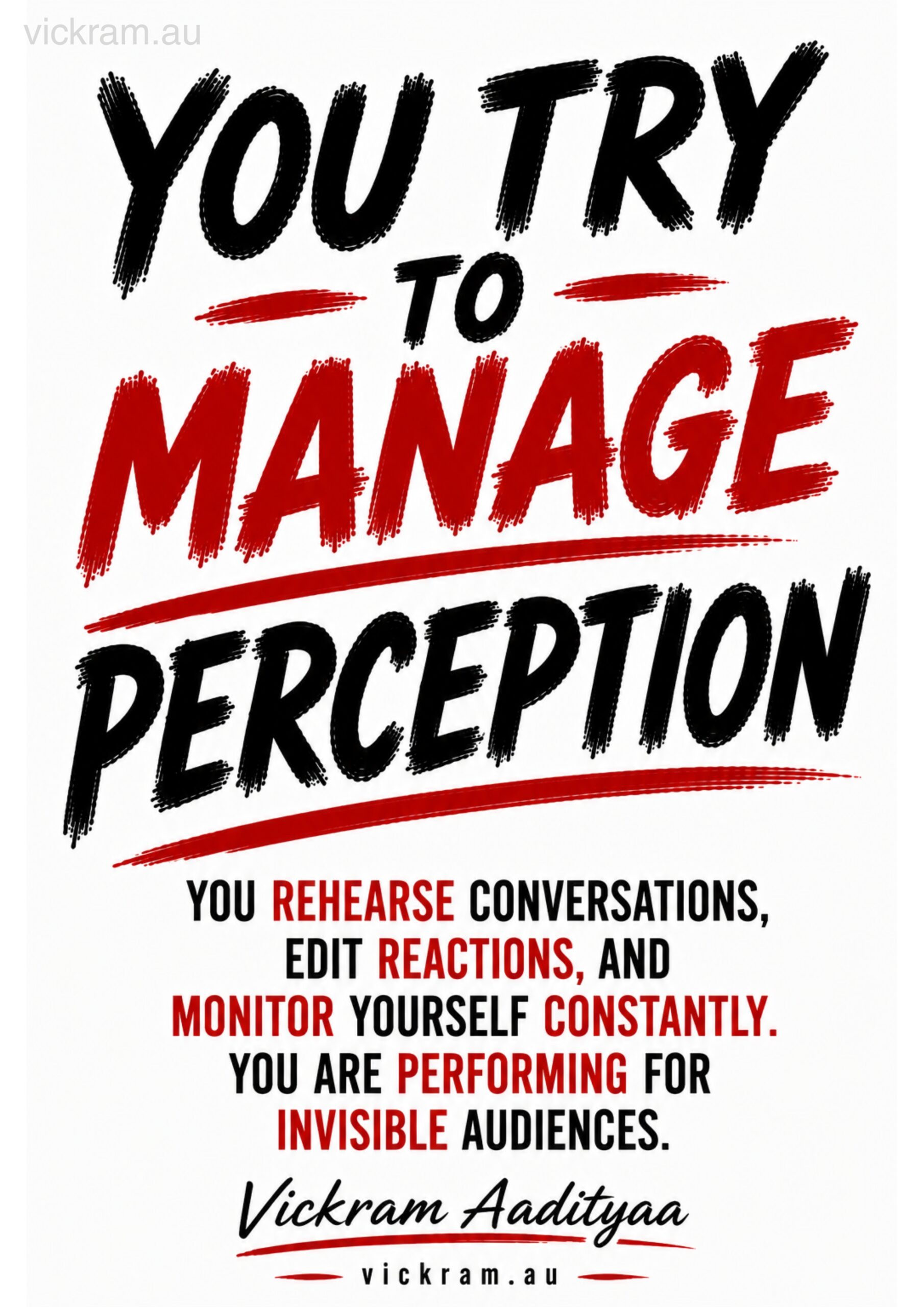
The conversation happens in real time. But in your head, it is already being edited. Before you finish a sentence, part of you is watching how it lands. Adjusting the next one based on the response. Monitoring the face of the person you are talking to. Reading for signs of approval or disapproval. Modifying accordingly.
You rehearse things before they happen. You replay them after. You think about what you should have said. You construct better versions of yourself in hindsight. You run imaginary conversations that never happen in the rooms they are imagined in. The audience for all of this is not always clear. Sometimes it is specific.
A person you are trying to impress or appease or avoid disappointing. Sometimes the audience is abstract. A general sense of how you are being perceived by the world, by history, by people who are not there and may not care. The monitoring is exhausting precisely because it never turns off. You are performing for a crowd that exists largely in your own mind. You are managing a perception that most people around you are too busy managing their own perception to actually form.
The energy spent on this is not trivial. It is a significant portion of the attention available to you. Spent not on what is in front of you, but on how what is in front of you reflects back on the image you are trying to maintain. What would it feel like to be in a room with no monitoring running?