Sacred Texts Dissected

You have been chanting these mantras your whole life.

At school. At temples. At the end of yoga classes. Before exams. After funerals. On loop in the background of a life you were too busy living to stop and examine.

Nobody told you what they actually say. Not because the knowledge was hidden. Because it was inconvenient. A mantra that asks you to think clearly is harder to sell than one that promises prosperity. A prayer that demands accountability is less comfortable than one that sends good wishes outward and leaves you unchanged.

This series takes the most chanted mantras, shlokas, and Mahavakyas in the Hindu tradition and reads them as they were written. Not as tradition handed them to you. Not as the spiritual marketplace repackaged them. As the original words, in their original context, with their original demand intact.

Some of what you find here will not sit easily. That is not accidental. These texts were not written to comfort you. They were written to disturb something that needed disturbing.

What you do with that disturbance is the only question that matters.

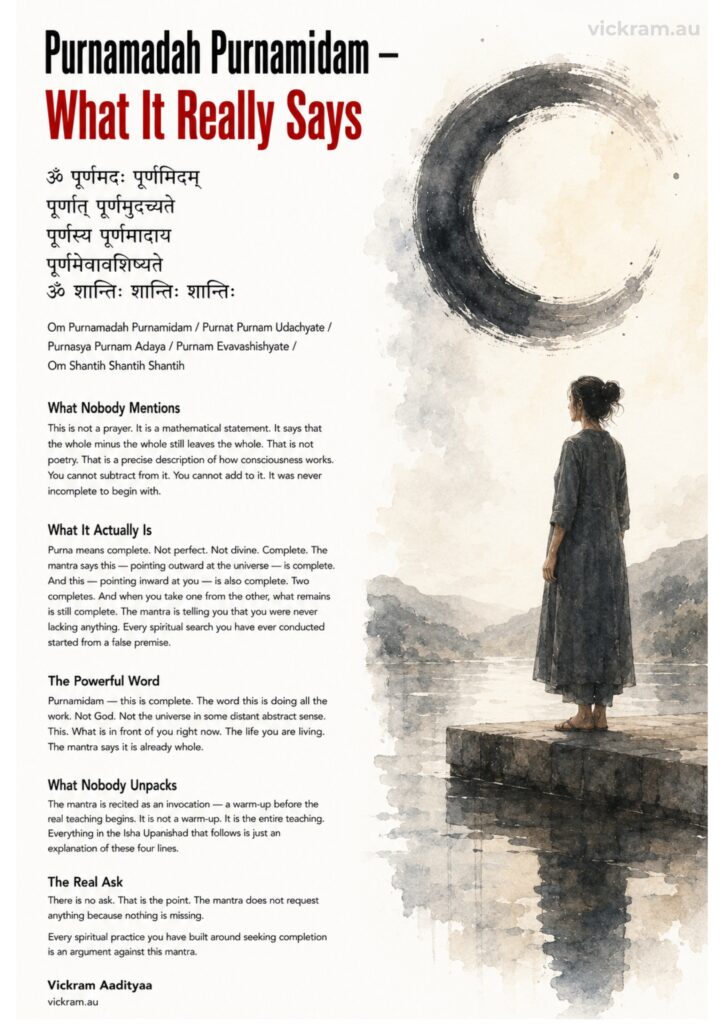
Purnamadah Purnamidam — What It Really Says by Vickram Aadityaa

Purnamadah Purnamidam — What It Really Says

Sacred Texts Dissected

Purnamadah Purnamidam is the opening invocation of the Isha Upanishad, one of the shortest and most profound Upanishads in the Vedic canon.

It consists of four lines built around the concept of Purna — completeness — and presents one of the most radical ideas in all of Indian philosophy: that both the universe and the individual self are complete, and that completeness cannot be diminished by any subtraction.

It is recited at the beginning of Vedic study and spiritual gatherings across India.
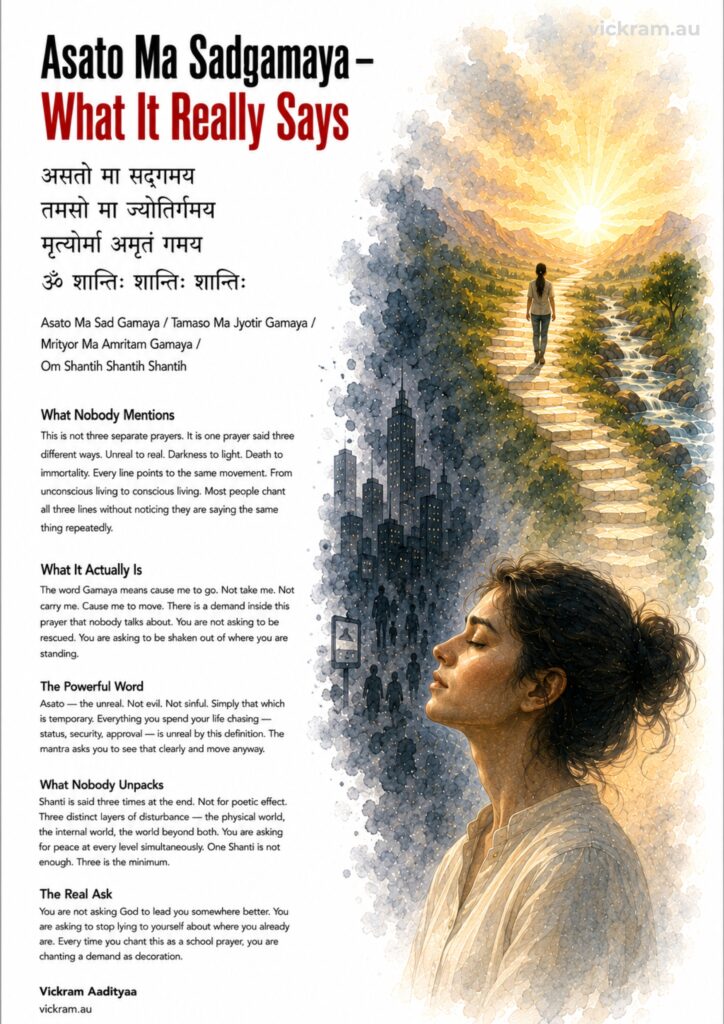
Asato Ma Sadgamaya — What It Really Says by Vickram Aadityaa

Asato Ma Sadgamaya — What It Really Says

Sacred Texts Dissected

Asato Ma Sadgamaya is a prayer from the Brihadaranyaka Upanishad, one of the oldest and largest Upanishads in the Vedic tradition.

It is part of the Pavamana Abhisheka — a purification ritual — and has been chanted across India for thousands of years at school openings, prayer gatherings, and spiritual ceremonies.

Its three lines form a progression from ignorance to knowledge, darkness to light, and mortality to immortality.

It is one of the most recognised Sanskrit prayers in the world.

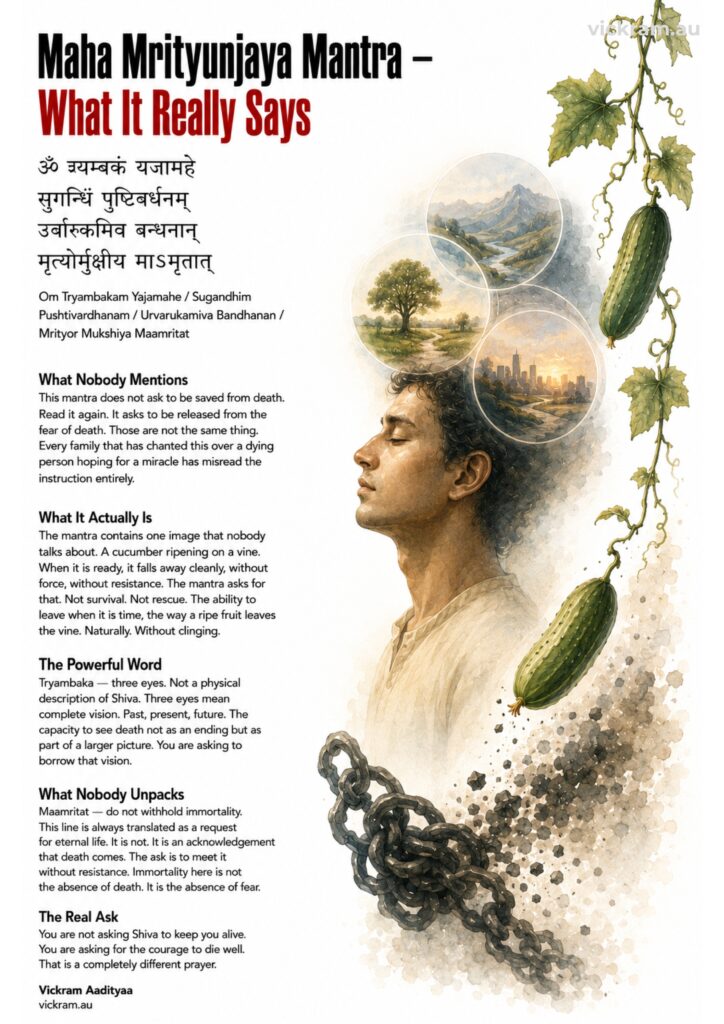
Maha Mrityunjaya Mantra — What It Really Says by Vickram Aadityaa

Maha Mrityunjaya Mantra — What It Really Says

Sacred Texts Dissected

The Maha Mrityunjaya Mantra is one of the oldest and most powerful mantras in the Rigveda, attributed to the sage Vasishtha.

It is addressed to Shiva in his form as Tryambaka — the three-eyed one — and is traditionally chanted at times of illness, death, and crisis.

Found in the Shiva Purana and the Yajurveda, it forms a central part of Vedic rituals across India.

It is also known as the Rudra Mantra and the Mrita Sanjivini Mantra — the one that revives from death.

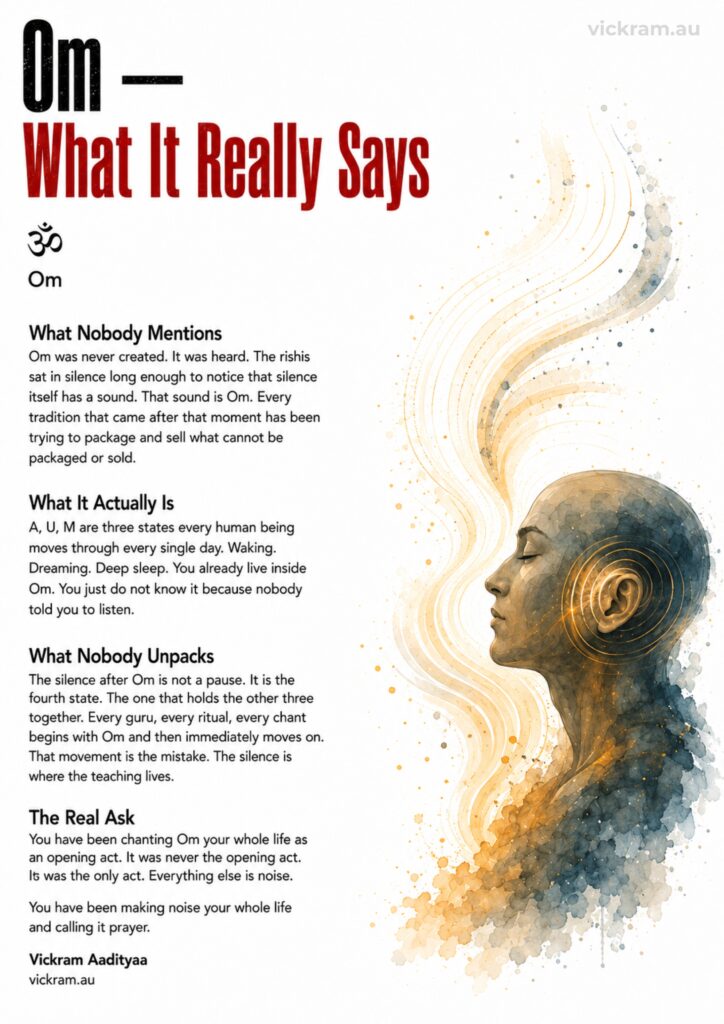
Om — What It Really Says by Vickram Aadityaa

Om — What It Really Says

Sacred Texts Dissected

Om is the most universal sound in the Hindu tradition, appearing across the Vedas, the Upanishads, and the Bhagavad Gita.

It is considered the primordial sound — the vibration from which all creation emerges.

The Mandukya Upanishad dedicates its entire twelve verses to unpacking this single syllable, breaking it into four states of consciousness: waking, dreaming, deep sleep, and the fourth state beyond all three.

It is chanted at the beginning of prayers, rituals, and yoga sessions across the world.

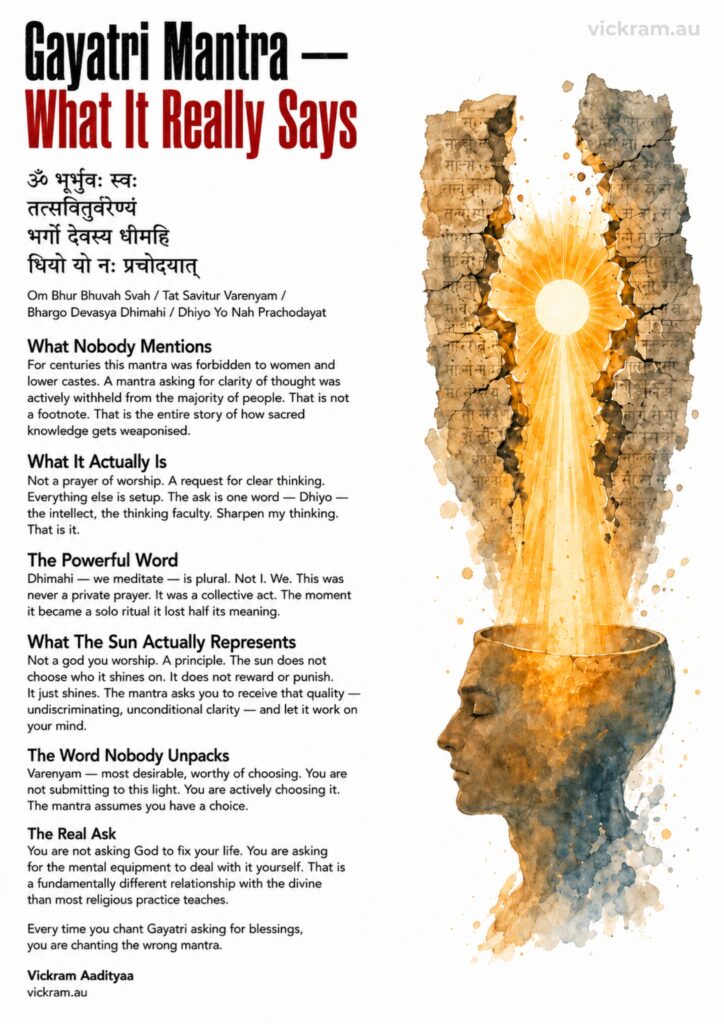
Gayatri Mantra — What It Really Says by Vickram Aadityaa

Gayatri Mantra — What It Really Says

Sacred Texts Dissected

The Gayatri Mantra is one of the oldest surviving prayers in human history, originating from the Rigveda over 3,500 years ago.

It is composed in the Gayatri metre — 24 syllables across three lines — and addressed to Savitur, the solar principle.

Traditionally chanted three times a day as part of the Sandhyavandanam ritual, it has been passed down through generations as the foundational practice of Vedic spirituality.

Today millions chant it daily across temples, homes, and meditation spaces worldwide, most without knowing what it is actually asking of them.

Scroll to Top